all posts tagged “rss”
The video that started it all, RSS in Plain English, was published 3 years ago today. We had no idea, three years ago, what we were getting ourselves into, but we're so happy that it has worked out the way it has.
Here's the original version of the video. The one that appears on this site (the one we license) has been updated for color and clarity.
The video currently has over 1.1 million views on You Tube and has been licensed hundreds of times. As much as the technical quality of the video makes me cringe, it goes to show that a video doesn't have to be technically perfect to be effective. Since that day, we've continued to publish videos on a monthly basis.
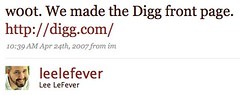
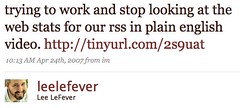
Here are a couple of Twitter updates from the day after we publised:
Good times. After three years, the process of publishing a new video still gets my blood pumping. More coming soon to Internets near you.
It's true. Two years ago today, we posted our very first video, RSS in Plain English. We had no idea what we were doing, or how that video would transform our lives.
We had a tripod, camera and a whiteboard, and that was about. The video was lit with bedroom lamps and I was speaking directly into the microphone on the camera as I moved around the pieces of paper. The video was edited with Windows Movie Maker. It was inspired by a blog post from 2004 with the title "RSS Described in Plain English."
Of course, the technical quality of the video clearly shows that we had many, um, many opportunities to improve:
We posted it about 10pm on the night of the 23rd and by noon the next day it hit the front page of Digg, partially thanks to our first comment by Rob Cottingham, minutes after it was posted. We were both blown away by its popularity. Here are a couple of tweets from that day:


This blog post (which makes me smile) captured some of the initial buzz:
It's been 24 hours since the video was posted and we've seen 15,000+ page views, 800 Diggs , 350 Delicious bookmarks and 50 comments.
Of course, the big question for us became, can we do it again? Soon after we started work on our second video, Wikis in Plain English. Once that was complete, we started to feel confident that this was something we could do.
Looking back at the RSS video, it's a bit painful to see how rough it is compared to our work now. However, I'm struck that the roughness didn't matter. It was the message, the script, the communication that mattered far more than the bad lighting and sound. While we feel good about technical quality now, we still focus the majority of our attention on what made that first RSS video work: a simple and clear explanation.
1000+ items. That's what Google Reader told me I need to read to catch up with my RSS subscriptions. It's intimidating. My RSS feeds were mocking me. I could see them with sneaky voices "hee hee, you'll never read me, you don't have the time. ha ha." The sad part is, they were right.
I stopped opening my RSS reader months ago. It wasn't a concerted effort, I just didn't do it. What I found was that longer I stayed away, the easier it was to stay away. Returns diminished with each passing day and at some point I gave up on reading anything via Google Reader. Now, I'm happy to report that I'm back on the wagon (I think that's the right analogy). My time away gave me some perspective on what I want to read and where I want to read it.
Culprit #1: Twitter
I was trying to figure out a clever title for this post along the lines of "Twitter Killed the RSS Star", but it wouldn't work. The sentiment works in my case however. I have integrated Twitter into my life and I think that it became a surrogate for reading blogs. Lots of people I follow share their blog posts on Twitter, I have found the relationships that are created to be more personal and it's all so lightweight. Watching Twitter updates gave me the feeling of connection, awareness and discussion that I love about blogs in an efficient and manageable package. Before I knew it, Twitter had replaced reading RSS feeds.
Culprit #2 Subscribing to the Wrong People
Looking back, my RSS reader has been filled with people I felt I should be reading. Let me repeat that - should be reading. I think that's a problem. I felt like I needed to watch TechCrunch to stay on top of tech news. I felt like I needed to subscribe to experts in my field(s). Sure, these subscriptions were educating me and raising my awareness, but I seriously question the cost/benefit. Reading them felt like homework - and I don't like homework.
This all came to a head recently when our best friends (and former Seattle neighbors) came to town and stayed with us. Within a little while, blogging came up and it turned out they had both posted a few entries in the run-up to the trip to Seattle. I had no idea. I had to tell them that I stopped reading blogs and I felt bad for not keeping up. These people matter about a million times more than the people clogging up my RSS Reader and I had let the 1000+items-of-things-that-don't-matter scare me away.
What I Did
Like I've done before, I started over. I opened up Google Reader, took a nice long look at the list and asked myself - does this matter to me? Do I even know this person? Will I be worse off without this content in my life? No. No. No. Nearly everything was wiped clean.
When I started adding feeds to fill the void, I did it with a filter. My RSS reader isn't for news, it isn't for niche analysis, it isn't because I "should". My RSS reader is now filled with subscriptions to sites that matter to me. These posts are written by people I know and care about. They make me feel like reading RSS is a treat - a few minutes spent being with an old friend.
It's only been a little while, but I think RSS may, once again, become a strong contender for my passive time. Now I can miss a day of RSS reading, open the reader and have Google Reader tell me I have 10 posts to read. That, I can do.
The Google Reader team hired us to create this one minute introduction to Google Reader.
Our other videos for Google include:
View all of our custom client productions.
Apparently, May 1st is RSS Awareness Day! I had no idea such a day existed, but it has it's own site at RSSday.org . Thanks to the nice folks at dailyblogtips.com for making our RSS in Plain English video part of the site - and day for that matter.
I agree that RSS is one of those special technologies. It has the potential to positively impact virtually every Internet user at no cost. A big problem is awareness - it's hard for people to see how it could impact them until they give it a try. Hopefully we've been able to turn some people on - but there are still about 94% of Internet users that haven't seen the light. The challenge continues.
Here's the improved version of the original video from the Common Craft Store:
A couple of weeks ago, we announced The Common Craft Store. It was a pretty soft roll-out, but was a huge moment for us. Not only did it mark the end of a lot of preparation, but a new business model. So far, so good. Plus, the more-ready-for-prime-time Store will soon be coming to an Internet near you.
A big part of preparing to open the Store was making new versions of each video in both Windows (.wmv) and Mac (.mov) formats. This gave us a chance to make improvements across the library - especially to our first few videos, which has sound and color issues.
The first example is a major update for the "licensed version" of RSS in Plain English video, which is only available in the Store. We recorded a new voice-over and re-edited it to be more efficient and have improved color. The content is nearly identical to the original, free version. Below is the updated, licensed version:
The second example is CFL Light Bulbs in Plain English (formerly New Light Bulbs in Plain English). When we originally published it, it did not contain a warning about mercury and disposing of the bulbs properly. This new version of the video contains a mercury warning. This updated video is now available in both free and licensed versions. Below is the updated, free version:
We're so excited about this new direction. We'll be providing all future Common Craft Show videos in free and licensed versions - and the licensed ones will be displayed in full length in the Store.
I remember the exact moment when it first became apparent to me that there was such a thing as an explanation problem. I was at a small conference on Silicon Valley in early 2004. There was a CEO of a start up there and during his talk, he mentioned RSS. Someone raised their hand and asked the question "What is RSS?"

This CEO's responses to the question, and I'm not kidding, was "RSS is an XML-based content syndication format." As you might expect, this was met with a look of bewilderment.

I was in the audience and had an AHA! moment. It was clear to me that RSS had an explanation problem that was preventing it from being adopted. Every time someone went looking for information about RSS and found that it was "an XML-based content syndication format" an opportunity was lost.
Since then I've been thinking a lot about explanation problems I'm starting to define them and the problems they cause. Ultimately, I think it's about adoption - adoption of an idea, a product or service. Good explanations increase adoption and poor explanations limit adoption. Here's how I'd explain it in Plain English.
An explanation problem exists when there is a mismatch between what is heard and what matters to the target audience.

Looking back at the RSS example, the question was asked by someone curious about RSS and the answer, while correct, didn't matter to the asker. The CEOs explanation didn't help them to see why they should care.
An interesting way to look at this situation is by considering how questions are asked. Often, when someone asks "what is...", they really mean "Why does it matter to me?" By considering what matters to someone, the answer becomes different and more likely to give them information they can act on.
One of the things that we've learned is that explanation sometimes means answering a different question than was asked. It's not always "what is it?" as much as "why should I care about it?"
Of course, the example with the CEO is what led me to write this blog entry (a month after the conference) and eventually, this video with Sachi.
Check this out... someone uploaded a bullshit version of our RSS in Plain English video to YouTube with a crappy ad on it.

I would love it if you could help me rectify this situation by reporting it to YouTube as inappropriate and/or leaving a comment on the video about it being a fake.
Update: After a handful of you good people left comments, the user has now removed the offending video. I think this was, in part, a cross-cultural misunderstanding - he is Malaysian. His comment to me showed that he saw no problem with the ad - he thought I was upset that he was getting credit for my work. I was impressed that he responded at all.
Updated: This is another one that isn't as bad, but still a pain. This person uploaded one half of the Wiki in Plain English video. Since the video is branded as Common Craft, these incomplete versions make a bad impression.
I really, really hope that I'm not going to have to fight this fight every day in the future.
Perhaps some of you may be thinking "Why did Lee make such a big deal about adding del.icio.us bookmarks to his RSS feed and then stop bookmarking completely?"
The answer is that I've been scared to. At some point a few weeks ago, Feedburner's Linksplicer (the tool that adds the bookmarks to the RSS feed) added some goofy characters to the feed and made it invalid - broken in a minor way.
If finally got this fixed (thanks to Feedburner's responsive support folks) and now I'm a little gun-shy. The bookmarked items will come back soon, I just want to make sure my feed stays valid along the way. We all need more validation, right?
The Verdict: Exceeded Expectations
You're going to have to forgive me, I'm about to spew all sorts of facts and figures while at the same time stroking my ego. I fear that it will sound like bragging , but we were completely blown away by the success of the RSS in Plain English Video and I want to share.
The video was posted on April 23rd, 2007. Today is May 28th and in just over a month the video has been...
- Viewed over 80,000 times across three hosts (Blip.tv, YouTube and DotSub)
- Translated into 9 languages (subtitles)
- Commented on 160 times (across sites)
- Dugg 975 times
- Added to Del.icio.us 795 times
- Linked-to over 680 times (says Technorati)
Of course, all this has been quite good for the Common Craft web site. In the same month, the site has...
- Gained over 400 new RSS subscribers
- Reached Technorati Authority of 980, Rank of 2146
- The blog entry containing the video has been viewed 46,000+ times and has over 100 comments
- Gained more visitors by maybe 20%
And this all culminates in one big objective for us: Let's try to do THAT again!
We have been working on making The Common Craft Show page more usable and of course, creating a new video which is just a couple of days from release. More info soon. Here is the banner for the new page.

I'm really trying to lower my expectations for the sophomore effort, but I can't help myself. I enjoy making and sharing these videos so much that it scares me.
- 1 of 3
- ››