all posts tagged “lightweight”

If you don't like yardwork, you have a choice. You can hire gardeners or you can plant things that don't require much care.
This is my way of saying that we all have a choice in how we grow. Because we want Common Craft to stay small, we look at new opportunities in terms of yardwork and ask ourselves - is this going to require gardeners in the future? If so, then maybe we should look for opportunities that are more likely to take care of themselves and allow us to focus on what really makes us excited and happy.
PS- We're signing off on this blog for a little while to spend time with family. Happy Thanksgiving to our fellow Americans!
1000+ items. That's what Google Reader told me I need to read to catch up with my RSS subscriptions. It's intimidating. My RSS feeds were mocking me. I could see them with sneaky voices "hee hee, you'll never read me, you don't have the time. ha ha." The sad part is, they were right.
I stopped opening my RSS reader months ago. It wasn't a concerted effort, I just didn't do it. What I found was that longer I stayed away, the easier it was to stay away. Returns diminished with each passing day and at some point I gave up on reading anything via Google Reader. Now, I'm happy to report that I'm back on the wagon (I think that's the right analogy). My time away gave me some perspective on what I want to read and where I want to read it.
Culprit #1: Twitter
I was trying to figure out a clever title for this post along the lines of "Twitter Killed the RSS Star", but it wouldn't work. The sentiment works in my case however. I have integrated Twitter into my life and I think that it became a surrogate for reading blogs. Lots of people I follow share their blog posts on Twitter, I have found the relationships that are created to be more personal and it's all so lightweight. Watching Twitter updates gave me the feeling of connection, awareness and discussion that I love about blogs in an efficient and manageable package. Before I knew it, Twitter had replaced reading RSS feeds.
Culprit #2 Subscribing to the Wrong People
Looking back, my RSS reader has been filled with people I felt I should be reading. Let me repeat that - should be reading. I think that's a problem. I felt like I needed to watch TechCrunch to stay on top of tech news. I felt like I needed to subscribe to experts in my field(s). Sure, these subscriptions were educating me and raising my awareness, but I seriously question the cost/benefit. Reading them felt like homework - and I don't like homework.
This all came to a head recently when our best friends (and former Seattle neighbors) came to town and stayed with us. Within a little while, blogging came up and it turned out they had both posted a few entries in the run-up to the trip to Seattle. I had no idea. I had to tell them that I stopped reading blogs and I felt bad for not keeping up. These people matter about a million times more than the people clogging up my RSS Reader and I had let the 1000+items-of-things-that-don't-matter scare me away.
What I Did
Like I've done before, I started over. I opened up Google Reader, took a nice long look at the list and asked myself - does this matter to me? Do I even know this person? Will I be worse off without this content in my life? No. No. No. Nearly everything was wiped clean.
When I started adding feeds to fill the void, I did it with a filter. My RSS reader isn't for news, it isn't for niche analysis, it isn't because I "should". My RSS reader is now filled with subscriptions to sites that matter to me. These posts are written by people I know and care about. They make me feel like reading RSS is a treat - a few minutes spent being with an old friend.
It's only been a little while, but I think RSS may, once again, become a strong contender for my passive time. Now I can miss a day of RSS reading, open the reader and have Google Reader tell me I have 10 posts to read. That, I can do.
This is the third in a series of posts about Being Lightweight. The first two were about Working with Clients and Tools We Use.
We are lucky to have a product that people like. Our challenge is to experiment and find the best ways to build a business around this product. To be successful we need the business to be profitable, but also work within the life we want to live.
We see this process as "business design" and as this series outlines, being lightweight is a big priority. Below are a number of ideas and thoughts about creating a lightweight business.
Two People - We are dedicated to being a two person company without employees. This is a fundamental constraint that guides nearly every decision. By making our size the priority, we have been forced to think hard about what is possible for two people and be prepared to focus on opportunities that work within this constraint.
Employees - We may work with contractors and short-term help, but we do not plan to hire employees. In the last article in the series I talked about the heavy nature of stress and anxiety. Growing the business by hiring would add potential revenue, but also add significant stress and loss of focus on our work in order to manage those folks.
Business Model - We ask ourselves - What business do we really want to be in? What do we want to be doing on a day-to-day basis? Consulting? Custom Videos? Licensing? Ads? Commercial? To be lightweight, we need to bring focus to the 1-2 models that get us closer to our goals and put others on the back burner.
Scalability - We are small, but we do want to scale the business. How? We consider business models. The custom video model does not scale - we would have to hire employees to make more videos each month. A more scalable model is selling licensed versions of our videos in the Common Craft Store. In this model, potential revenue is not tied directly to production time.
Not Doing it All - When opportunity knocks, it's hard not to answer. The problem is that we can't do it all and we've learned to say no, even if it hurts sometimes. The key is being clear about our future goals. If an opportunity doesn't take us there, then it's creating drag.
Marketing - We don't spend time on brochures, fliers or ads of any traditional sort. We believe that the best marketing doesn't always come from a campaign - it comes from the users of our products. We focus on making free versions of the videos easy to share.
Agility - About a year ago, a few companies started to become interested in our custom videos. We literally woke up one morning and decided to focus 100% of our business on these videos. The same thing happened when we decided to focus on the Store. Our goal is to retain this freedom to react to changes and opportunities efficiently, and avoid the need to seek approval from others. A beauty of being small and lightweight is the ability to react.
People Philosophy - We believe that people are essentially good and given limited resources, we'd rather focus attention on being open and helping them do the right things rather than trying to make the wrong things impossible.
Balance - We don't believe in working 80 hours a week, 51 weeks a year so that you can vacation when you're old. We work more hours than most, but we're not bashful about making sure that we live a fun, interesting and balanced life. Lightweight businesses make this easier.
Investors and Partnerships - Often, these are required for business growth. The problem comes when the requirements and expectations of others become a part of the business. We've been careful not to form agreements with investors or partners because the baggage these relationships create may not balance with the benefits they provide. It's added stress and anxiety that creates weight we would rather not have. Advice is great, but financial relationships weight a lot.
Limited Middlemen - Each person who handles a product on the way to the consumer adds weight and removes reward. We look for the best ways to get our product from an idea to the customer as directly as possible. Outside of us, The Common Craft Store doesn't have salespeople, distributors, marketers or support. We do it all, A-to-Z, using products like PayPal and e-junkie.
Contact Points - As our visibility on the web has increased, so too has our time managing communication. We recently decided to make email our most public source of contact and have removed our phone number from the web site. It's nothing personal, it just allows us to do a better job managing communications as lightweight as possible.
Supporting Two People - At the end of the day, we remember that we are two people. Sure, our model may not enable us to dominate markets or become a Fortune 500 company, but that's not our goal. We need our business to support us and the life we want to live.
So, you might be wondering about the result of all these ideas. Well, we've made a number of decisions lately. Our future is devoted to building a library of videos for the Common Craft Store. We are phasing out custom videos and devoting time to videos we can license to influencers and educators for use in the workplace. This model enables us to be lightweight and 100% independent.
Ultimately, we want to wake up each morning and know we are choosing what we do that day. For us, that's lightweight.
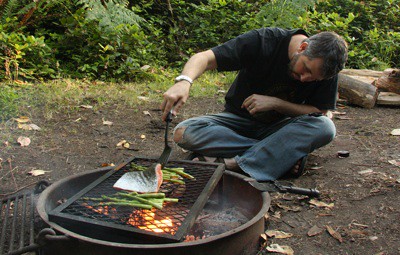
I suppose some would say it's downright un-American, but we worked on July 4th and 5th. It was our choice - a choice that enabled us to take the 7th and 8th and go camping without the hordes of people. It's something we do often - work when others aren't so we can play without crowds. It's a choice we make.

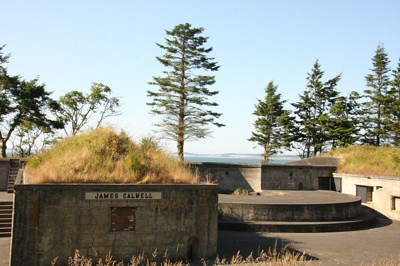
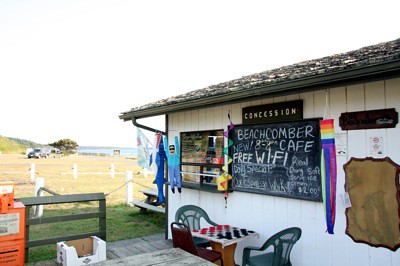
On this camping trip, we met someone whose attitude reminds us a little of our own. She runs the tiny "Beachcomber Cafe" at Fort Flagler State Park . Fort Flagler is situated on the Strait of Juan de Fuca - the waterway that creates the entrance to Puget Sound from the Pacific. In war time, it was a strategic location and now has decaying, 100 year old bunkers, turrets and battlements. An interesting and beautiful place to explore.
We camped up on a bluff and a short walk down the hill was the cold, windy beach and Beachcomber Cafe. The first thing we noticed on the approach was the chalkboard outside that said "free wifi".
Free wifi out here in the far reaches of the country. Cool! We walked in and talked a bit.
Me: So, is the wifi on during business hours?
Her: Nope, 24 hours. I'd probably forget to turn it off anyway.
Me: Is there a password?
Her: No, it's not worth keeping up with a password
Me: It's really great that you offer it way out here
Her: Yeah, you know, it would be a pain to try to make money on it. My little shop here may cost a little more than other places, but if you use the wifi, you might consider buying a little something. It's up to you.
Me: What hours are you open?
Her: 8 to 8
Me (to Sachi): See Sachi, she even figured out how to make the hours easy.
Her: Hah! Now you're getting to know me!
We figured that Common Craft and the Beachcomber Cafe have some things in common. The Beachcomber Cafe has made choices in how the business is run. Sure, they have the potential to try to squeeze every dollar out of people who need wifi, but they don't. They provide wifi as a worry-free service and rely on the good nature of people to support the business in other ways.
Further, they put a priority on the lightweight choice - the wifi is always on, always free and open to everyone. Any other way would create more hassle than she needs. The store hours are even easy to remember.
I'm not talking about business practices, but philosophy - a philosophy that's built on shedding unneeded administration and focusing on providing opportunities that give people ways to feel good about the relationship.
The first step is realizing you have a choice. Your business doesn't have to operate like others. Sure, you can make 8 dollars a day on wifi, or you can smile at your customers and tell them the wifi is free and goes great with today's paper and a candy bar.
Here's a photo set from the trip, if you're interested.
This is the second in a series of posts about being lightweight. Our first was focused on working with clients and this installment is all about tools we use.
Tools, or the the wrong tools, become a risk when they create unnecessary drag in every day work. Often, we've found ourselves wondering if we're using a sledgehammer to drive a nail. If so, we look for alternatives.
In being lightweight, we also consider mental and emotional baggage that goes along with tools. We're often willing to pay for peace of mind and look for tools that remove anxiety. Anxiety is very heavy for us and we always want to reduce it.
Here are some of the tools, services and ideas that we use to be lightweight. Your mileage may vary.
Web Site - We're fans of content management platforms like Drupal, Wordpress, etc. We only know basic html, so when we're working with designers on a new Common Craft site, we make easy, lightweight management a big priority. I've wasted too many hours trying to write code. Technology often stands in the way of what I want to share on the web - and that's a shame.
Hosted Services - We're not technical people. Maintaining our own
server sounds like hell to us. So, we use hosting services for
everything we do. Our web site, our videos, our photos are all on
servers that are maintained by others. Choose them well, let the specialists do their
jobs and get out of the way.
Documents - Google Docs has had a huge impact on our workflow. We do a lot of editing together and there simply isn't a better way to work on the same document at the same time. Attachments are too heavy.
Video Sharing - Often we need to share a 50mb video file with a client. We could send a CD, we could FTP it. Instead, we use hosts like Vimeo.com that have good privacy options. This makes life easier on us and the client - all they need to share the video with co-workers is to share the link and password. Plus, they can watch the video in Flash and choose to download it it too.
Social Networking - We have presence on the major social networks, but they aren't a part of our day-to-day work. We have serious questions about the time it takes to really make the networks work, especially Facebook. It seems too heavy for me to have to use multiple inboxes across the networks. We love Twitter because it's lightweight - it's a direct line to part of our community that doesn't require clicking a link in email.
Bookkeeping - When I started Common Craft in 2003, I bought Quickbooks because I thought was what you're supposed to do. It was a way, way too much for me. Even today, we are more than happy using spreadsheets to track our books (Sachi is a spreadsheet ninja). For many small businesses, Quickbooks (and similar programs) are often a heavy, cumbersome way to deal with the books. Do you need all that?
Home Network - We have all our computers, printers and music system hooked together wirelessly. We used to have to take a laptop to the printer in another room to print. We used to have to get up to change the music. It's a small thing, but a nice home network (run by Apple's Airport Extreme and Express) makes life a bit nicer.
Home Environment - We spend a lot of time at home. Because we're here so much, we've agreed that we will invest in making home like we want it - comfortable and easy. Home should not feel heavy or cause anxiety. If you can't make home like you want it, what can you do?
Back Ups - Like most, we are horrible about remembering to back up our files. The thing is, we shouldn't have to remember - this is stress that has a cure. We use Mozy that keeps everything backed up automatically. Peace of mind is lightweight.
Selling Digital Downloads - We have been very impressed with e-junkie as a means for selling digital downloads. You upload a file and e-junkie provides an "add to cart" button that works on almost any web page and a flash-based shopping cart. It's a perfect solution for The Common Craft Store - e-junkie handles everything and provides the right tools for managing customers.
Mowing the Lawn - Yes, it's true. We recently purchased a rechargeable electric mower called a Neuton. We've gone through a dirty, loud mower every couple of years and those things are a PAIN. Our new mower is perfect - it starts immediately, mows for an hour on a charge, is clean and so quite you can hear the blades being chopped.

Reading - I'll write more about this later, but I recently bought a Kindle - Amazon's e-reader. It's poorly designed in some ways, but it makes books and especially newspapers feel heavy, cumbersome and wasteful. I am a big fan.
Future - I'm currently lobbying Sachi to get a scooter. I think we can get rid of one of our vehicles and replace it with a scooter over time. Scooters are lightweight in so many ways - gas, parking, convenience.
So, this concludes the tools part of the series. I hope that you will look at the tools you use every day and think about the alternatives - and don't forget about anxiety - what could be the heaviest thing of all.
Next Up - Being Lightweight: Business Design
It's a question we ask each other all the time - what is the most lightweight way we can do this?
We are a small company who is trying to do big things. In order to be
successful, we need to reduce drag - to remove the processes,
bureaucracies and commitments that slow us down and don't pay off.
Today we're kicking off a series of posts called "Being Lightweight" that will relate what lightweight means to us and hopefully help you think differently about how you focus your attention.
Working with Clients
Over the past year, we've evolved in how we manage our work with clients on custom videos. Here are a few things that we do that helps us move quickly and stay lightweight.
Face-to-Face Not Required - We've never met the vast majority of our clients face-to-face. I'm sure it would be nice, but we don't think it's required to produce a video. What it does do, is cost both sides a lot money and take a lot of time that could be used for creativity.
Project Pricing - In terms of the time it take to create a client video, our projects are similar. To keep ongoing billing and at a bare minimum, we price by the project. For us, billing by the hour would create another process that would create drag and introduce a time limitation that may impact the quality of the end product.
Video Development - We apply the 37 Signals concept of "getting real " to developing custom videos. We involve the client at nearly every step along the way, starting with the script. This lowers the risk that big changes will come late in the process and waste time on both sides.
Expectation Setting - Early in the relationship, we take a leadership role in outlining our system for completing the project. We've found that it helps everyone to have structure. We set an expectation about response times and work to make sure that the project lead owns as many decisions as possible.
Single Point of Contact - We ask that we have a single point of contact on the client side. This person is our contact, but also a filter for input from their organization.
Of course our business is somewhat unique and every project is different. However, I think that many projects get behind or off track because they are burdened with overhead, processes and bureaucracy that add weight without adding productivity. Being lightweight in client relationships requires setting expectations, shedding as much weight as you can and focusing on what really matters.
Next up - Being Lightweight: Tools We Use