all posts tagged “plainenglish”
We've published a new video called "Secure Websites in Plain English"
Security is obviously an important part of using the Web. Thankfully, through cooperation between a number of organizations, standards have been developed to communicate when a site is secure. Unfortunately these clues are not always known to everyday Web users. This video covers the basics of web site security - the common threats, the basics of encryption and how to tell when a site is secure.
The video also covers a new and growing standard that gives banks and other organizations a way to communicate that their site is the genuine article. This new standard, called EV SSL Certification, is meant to battle phishing scams.
This video, like all our videos, is available for licensing and use by individuals, organizations and websites. Learn more.
Here are other videos in our growing "Net Safety" series...
Phishing Scams
Protecting Reputations Online
Today we published a new video called Protecting Online Reputations in Plain English.
Aimed at younger or inexperienced web users, this video helps explain the long-term risks of sharing inappropriate photos, videos and stories on the Web. We've seen the stories and heard personal accounts about people who shared an inappropriate photo that eventually caused them to lose their job or miss an opportunity. Preventing this kind of problem can come from increased awareness about how the Web works and what it means to share something with the public. This video is about taking responsibility and making choices to protect reputations.
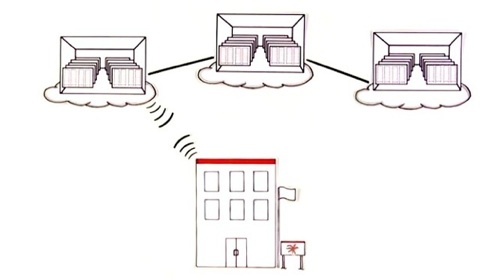
Today we published a new video called Cloud Computing in Plain English:
This title has been one of our most requested and for good reason. Cloud Computing is a subject that has an explanation problem - people have a hard time understanding it because it's difficult to explain quickly. Like Social Media, it's a subject that is very broad and lacks broad consensus in terms of clear explanations. Our hope with this video is to lay bit of groundwork so people can see the big ideas.
We asked a number of people for input on the video and I want to thank: Tony Wright, Chris Savage, Uri Budnick, Jeff Dickey and lots of others who I bugged over the last year.
Lastly, this video is available for embedding with a monthly subscription fee. If you're interested, learn more or contact us.
Today we've published a new video "Saving for Retirement in Plain English".
Since we first considered making the series of videos on Money, we've had our eyes on retirement savings. Not just our retirement, but yours. Too many people start saving too late and/or don't know the basics of why retirement accounts like 401ks and IRAs make sense. This video is aimed at helping people see the long term benefits of retirement accounts.
Who is it for? Along with use in schools, we see this video being a tool for companies who offer retirement programs. This video can be licensed for use by HR (or financial organizations) that have the goal of increasing awareness and adoption of the programs.
This video will join the other Money videos in a forthcoming "Financial Basics Pack" of 6 videos:
The release of this video also marks a break for our recent focus on money and a return to technology. More coming soon!
Well, it was a good run. Twitter recently redesigned their home page and the link to the Common Craft video "Twitter in Plain English" has been removed. Here's the story of how it got there:
Back in February of 2008, I shared the video with Twitter co-founder Biz Stone. After making a handshake deal, the video appeared via a "watch a video" link from Twitter.com.
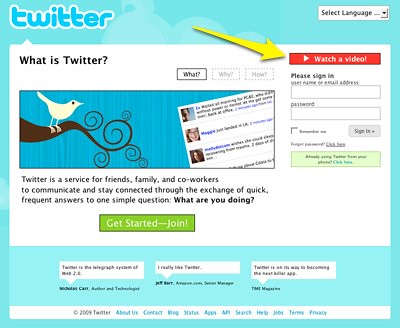
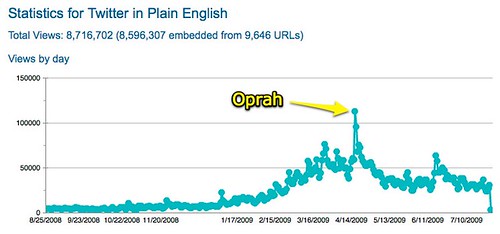
Twitter decided to use the dotSUB player for the displaying the video, which enabled the video to be watched with subtitles in many languages. The video has since been translated into 69 languages. As of today, about 1.5 years later, that video has been viewed over 9.4 million times via the dotSUB linked from Twitter.com.
The Twitter folks put a link along with the video to CommonCraft.com, which sent a lot of people in our direction.
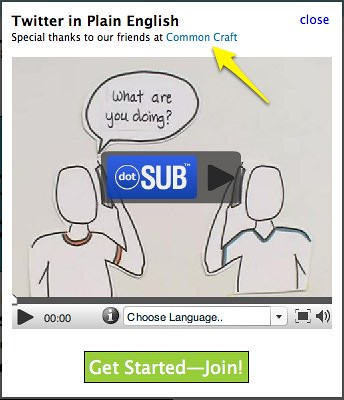
Now that the page has been redesigned, the link to the video and to Common Craft are no more. But we're not sad. We're so honored to have been a part of helping educate people about Twitter - a simple idea that's very hard to explain. In the end, Twitter helped raise the visibility of our work and the work of explainers in general. We heard many, many times "We want a video like you did for Twitter." Thanks to Biz, Ev and the Twitter team for giving Common Craft the opportunity to a part of an amazing trajectory. We'll never forget it.
While the video isn't linked via on Twitter.com, it's obviously alive and well on CommonCraft.com. We recently published Twitter Search in Plain English as a follow on.
Today we released a new video called "Twitter Search in Plain English"
The video uses an metaphor of the small town of "Twitterville." The town has an election and the people use Twitter to track real-time news, a hashtag to organize discussions and trends to find new information.
While it wasn't our intention, the video matches closely with the events currently taking place in Iran, where people are using Twitter to organize and share news about their disputed election.
If you know people who get Twitter, but don't understand things like hashtags and trending topics, this video will help.
Today we published a new video called "Preparing an Emergency Kit in Plain English." 
This video represents a new kind of relationship for Common Craft. A while back, we were contacted by Public Safety Canada (PSC) about this subject and we saw a couple of opportunities. First, we could work on a video that has the potential to have a positive impact. Second, we saw an opportunity for a win-win in terms of the video's ownership - something we call a hybrid relationship.
Emergency kits are a widely accepted part of emergency preparedness and most agree on what a kit should contain. The opportunity we saw was to work with PSC to create an emergency kit video that would fit their needs and give us an opportunity to offer a similar video for licensing on commoncraft.com. So, PSC received a video built for their Canadian audience and we have a video with versions appropriate for our American audience. We see this as a win-win and enjoyed working with PSC to make it happen.
This video offers governments and organizations focusing on emergency preparedness a quick and effective way to help citizens get started on building their kits. It can be licensed and branded for use in training and education, or on public facing websites.
Andrew Pegler, plain English writer and editor, is frustrated by the language that dominates business and law. In "Join Winnie's War and Mind Your Language" he has harsh words for what passes as communcation these days:
As a practising plain English editor and writer, I can assure you this
battle is coming at us on many fronts, from the supermarket shelves to
our national capital. It is fed by intellectual vanity, fear of looking
dumb, pesky lawyers (of course) and a public that has been bludgeoned
into submission by its heavy, dull, self-important pedantry. This enemy
of clarity and friend of the obscurantist feeds off our numb acceptance
of it in our everyday lives.
Fight the good fight!
These jumbled assaults on my beloved English seem designed to
intimidate, depersonalise and, I suspect, divert the reader from the
fact that the writer does not really have an answer. Scratch the
surface and you are in free fall, for these battalions of nothingness
often carry no precise meaning.
Plain English as transparency. Nice.
Siegel+Gale recently completed a year long study of 1,214 American
homeowners and investors that shows huge demand for simple, plain
English communications. A few interesting quotes:
Fully 84% of all consumers say they are more likely to trust a company
that uses jargon-free, plain English in communications. And 79% say
they think it is “very important??? that President Obama “mandate that
clarity, transparency, and plain English be a requirement of every new
law, regulation and policy.???
Three-quarters of survey respondents (75%) say that complexity and lack
of understanding have played a significant role in the current
financial crisis. Moreover, 63% of those surveyed feel that “banks,
mortgage lenders and Wall Street intentionally make things complicated
to hide risks or to keep people in the dark.???
The survey asked how much of an impact jargon-free, plain-English
explanations and disclosures would make on consumer interest in a
number of categories. Consumers reported:
a 79% increased interest in investing in a financial product,
a 73% increased interest in selecting a broker or a financial advisor,
a 67% increased interest in purchasing a life insurance policy,
a 63% increased interest in taking out a loan, and
a 63% increased interest in applying for a credit card.
I doubt this comes as a big surprise. I think we as a population have become desensitized to government, legal and financial jargon to a point where we assume it's the only option. We muddle through it, hire people to translate it and hope for the best. It's a sad state of affairs and one that can change. We have to demand it. We have to show that it's wasteful and counter-productive.
The hardest part is admitting that we don't know or that we're confused. When we're sitting in that office, we want to show that we're smart and on the ball. When the jargon starts flying, it's too easy to nod and say "ok." I do it too. If we're serious about changing this kind of communication, we have to be ready to say "I don't get it" and "I need you to help me understand using simple language." It's nothing to be embarrassed about - as customer, we have the right to demand clarity. In the end, it's the businesses and organizations that can provide this clarity that will have a better chance of finding success in the future.
Common Craft was hired by Microsoft to help explain the new Windows Live.com. We were so excited to work with a local organization on a project that highlights a new direction for the company.
Share this video with this code:
- 1 of 2
- ››