Login

all posts tagged “dotsub”

Twitter.com Now With Less Common Craft

Posted by: leelefever on July 28, 2009- 5:00pm

Categories: dotsub, plainenglish, stats, Twitter

Well, it was a good run. Twitter recently redesigned their home page and the link to the Common Craft video "Twitter in Plain English" has been removed. Here's the story of how it got there:

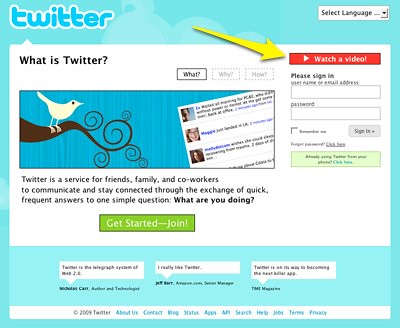
Back in February of 2008, I shared the video with Twitter co-founder Biz Stone. After making a handshake deal, the video appeared via a "watch a video" link from Twitter.com.

  twitter_homepage by you.

Twitter decided to use the dotSUB player for the displaying the video, which enabled the video to be watched with subtitles in many languages.  The video has since been translated into 69 languages.  As of today, about 1.5 years later, that video has been viewed over 9.4 million times via the dotSUB linked from Twitter.com. 

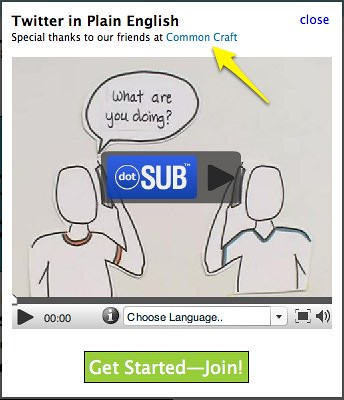
The Twitter folks put a link along with the video to CommonCraft.com, which sent a lot of people in our direction. 

twitter video cc link by you.

Now that the page has been redesigned, the link to the video and to Common Craft are no more. But we're not sad. We're so honored to have been a part of helping educate people about Twitter - a simple idea that's very hard to explain. In the end, Twitter helped raise the visibility of our work and the work of explainers in general. We heard many, many times "We want a video like you did for Twitter." Thanks to Biz, Ev and the Twitter team for giving Common Craft the opportunity to a part of an amazing trajectory.  We'll never forget it.

While the video isn't linked via on Twitter.com, it's obviously alive and well on CommonCraft.com. We recently published Twitter Search in Plain English as a follow on. 

How "Twitter in Plain English" Gained 2.6 Million Views

Posted by: leelefever on February 18, 2009- 4:00pm

Categories: business, dotsub, stats, twitter, video

A year ago today, I was writing the script for the video "Twitter in Plain English."  A year later, the video has over 2.6 million views, thanks to a bit of collaboration between a handful of companies. Here's how:

We decided to make "Twitter in Plain English" for the same reason we made "RSS in Plain English " - it was a concept with huge potential that needed a better explanation. We wanted people to understand a resource that we value.

Twitter, Inc. didn't hire us to create the video and had no creative input on the project.  However, I did share the video with Biz Stone and he saw opportunities.  We made a simple deal where they could use it on their site and we retained all rights, etc.

Around April of 2008, this button appeared on Twitter.com, linking visitors to the video and our web site.
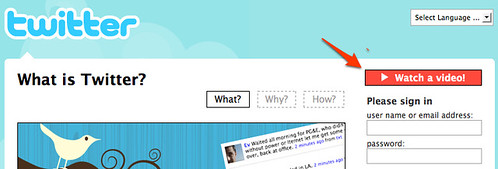
Twitter Stats by you.


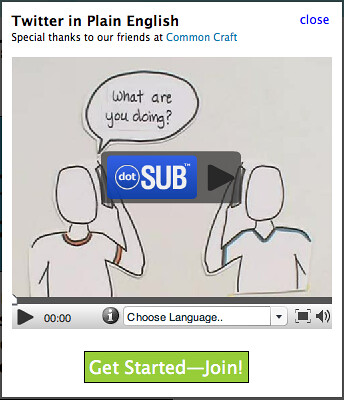
We loaded the video to a few hosts, like YouTube, Vimeo and dotSUB. Twitter chose to use the video player from dotSUB.com.  If you're not aware of dotSUB, it's an amazing free service that enables any video to have subtitles in mutiple languages.  Twitter embedded the dotSUB player and the ball began to roll.

Twitter_ player by you.


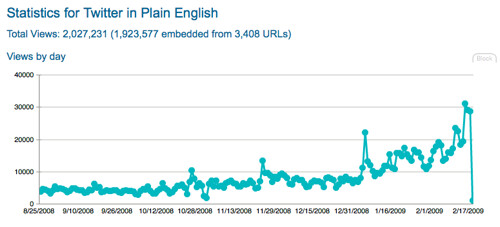
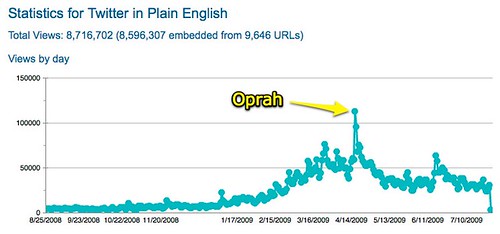
Fast-forward to today and it's clear that the video has been a hit. Here's a graph of the daily views over the last year six months via dotSUB:

Twitter Stats by you.


I think it's interesting to see the "hockey stick" formation over the last couple of months.  My guess is that this is an indication of the growing number of people visiting Twitter.com.  2 million views on dotSUB are added to 600k on YouTube and 70k on Vimeo to get to 2.6 million overall views.

Michael Smolens, a friend and someone who founded dotSUB.com shared the stats this way, regarding the Twitter video on dotSUB:

The number of daily views is now at more than 30,000/day, up from 6,000/day 3 months ago.  It is now in 53 languages, and is embedded on 3,397 different URLs.

Thanks to dotSUB's free, volunteer-based subtitling service, the video can be embedded and viewed with subtitles in 53 languages, making it accessible globally.

What I love about this story is that it's a win-win that's not predicated directly upon making money.  We made the video on our own time.  Twitter chose to use a free video service that opened the video to a global audience.  Almost a year later, and Common Craft is getting a lot of referrals from Twitter.com and licensing deals, Twitter gets a video for explaining their service, dotSUB gets a perfect way to expose the value of their service and the people of the Web get a fun video that explains something that's difficult to understand. Win-win-win-win?

NOTE: In terms of our business model, Twitter is an exception, as we believe it is an exceptional product. At this stage in our evolution, I don't want to set the expectation that we will produce product-based videos on our own time.
Help Translate the Google Docs Video on DotSUB

Posted by: leelefever on September 20, 2007- 5:00pm

Categories: clientproduction, dotsub, google, language, paperworks, plainenglish, transcript, video

We've been friends and fans of dotSUB since we first started making video for The Common Craft Show.  They make it easy for videos to be translated into multiple languages via subtitles. 

The RSS in Plain English video has been translated into 20+ languages on dotSUB. A truly useful and innovative service.

I've gotten permission from the Google Docs team to share the Google Docs video on dotSUB so it's acessible for the hearing impaired and our non-English speaking friends.

Are you bi-lingual?  Multi-lingual?  Please help us get the Google docs video translated.  All you need is a dotSub account and a visit to the video's page (right side) to start the translation.  

Here's the video in the dotSUB player - you can click the arrows at the bottom to see other languages (once the translations are complete). 

Wiki Video in Multiple Languages via DotSub

Posted by: leelefever on May 30, 2007- 5:00pm

Categories: cooltools, dotsub, language, lesson, show, video, wiki

Just after posting our first video on RSS , I learned a few valuable lessons:

1. Video is inaccessible for the hearing impaired

2. Video is not easy to translate into other languages

3. There is a new site that addresses both of these issues called DotSub .

DotSub makes it easy for me to transcribe the spoken words into text subtitles. Then, once the subtitles exist, it enables DotSub members to voluntarily translate the text into other languages and post the video to their blogs. This makes videos international and more accessible - for free.

So far, the Wiki video has been translated into Chinese, Dutch, German and Swedish . The RSS video has been translated into 11 different languages . I'm just amazed.

Here is the Wiki video in a player that allows you to change languages. Use the Up^ and Down arrows at the bottom to see the subtitles.

Recent Post Topics

Subscribe with RSS