Login

all posts tagged “legal”

New Video: Copyright and Creative Commons

Posted by: leelefever on February 7, 2012- 10:04am

Categories: copyright, creative, creative commons, IP, legal, New Video

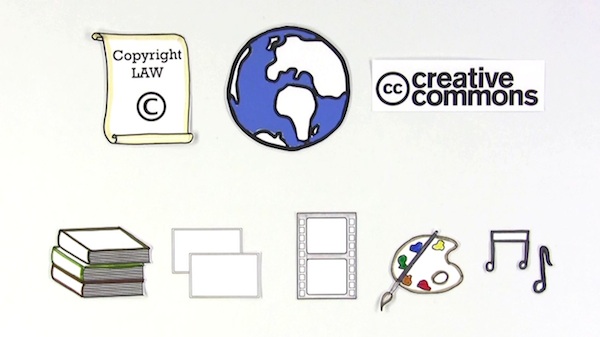
Today we’re announcing a new video: Copyright and Creative Commons - Explained by Common Craft.


One of the exciting things about having Common Craft members is working with them on ideas for future video titles. We provide them tools for suggesting and voting on future titles and this idea came directly from the members. Yaay!

About the video:

This video tells the story of a photographer who learns the basics of copyright law and creative commons licensing. Her story highlights the role each can play in helping creators protect and share their work.  It teaches:
 
• Why copyright law exists
• How to copyright a creative work
• Creative Commons licensing basics
• How both copyright and Creative Commons licensing can help creators
• Rules of thumb for using licensed work

A few photos from behind the scenes:

Sachi Cutting

Materials ready to shoot

Everything on deck


Licensing Your Trademark - A Positive Alternative

Posted by: leelefever on August 24, 2010- 5:00pm

Categories: legal, Licensing, ourwork, strategy, trademark

For a couple of years now, through our work with videos, I’ve realized that licensing is an often neglected business model.  Not only is a potential revenue source, it’s a way to work with people in a positive and permission-based manner.

Patrick O’Keefe, author of Managing Online Forums, recently wrote a post that got me thinking.  It’s called “Rethinking the Cease and Desist - Don’t Threaten Fan Communities and Groups - License Your Brand to Them.”  Patrick is a professional community manager and has a lot of real-world experience in dealing with fan communities - and I think he’s 100% right.

I believe I have the solution. You have to control your trademark. You also don’t want to abuse your vibrant fan base. You feel you are between a rock and a hard place. The solution? License your brand to the site and/or it’s proprietors.
Provide them with a license allowing them to do what they are already doing.

Let’s take a step back and talk about the issue at-hand.  If you own a trademark, like “Common Craft” you must protect it.  If you don’t, you could lose the ability to protect it in the future.  For this reason, you have to be proactive. Unfortunately, enforcing a trademark can be messy.

If you’re a major brand, you have lawyers who are constantly scouring the web for people who use the trademark in illegal ways.  For instance, if I used the Coca-Cola logo to advertise my new drink, they would surely send me a nice letter.

For small companies, it’s sometimes not so simple.  While enforcing your trademark is your duty, you have the real potential of ruining the goodwill you’ve built among your customers and fans by handling the situation in a clumsy way.  

There are the obvious cases where an organization is clearly trying to create confusion by using your trademark to promote their own products.  This is an easy one - a cease-and-desist is often the only thing that will cause them to stop.

Most often though, the person or company violating the trademark (for example, using your logo without permission) does not have bad intentions. They are a fan who wants to use the trademark to help you - not take business from you.  This is a simple case of awareness.  They either didn’t know it was trademarked, or didn’t understand the basics of trademark law.  It’s these cases that are the hardest because a cease-and-desist will seem misplaced.

This is where licensing comes in.  As I’ve written before, licensing is the business of permission. You have the right to control your intellectual property, whether it’s your words, music, videos, logos, etc. and licensing is how that control is often managed. Trademark is a tool that makes licensing possible - they give you legal authority to control what you own.  

So, to Patrick’s point, what seems like a trademark violation may be a business opportunity, or a way to have a formal, productive relationship with fans.  

Let’s say one of your fans wants to start a blog about your brand.  Without asking, they grab a logo from the web and start a blog, maybe with the name of your company in the URL.  You notice it and realize that they are violating your trademark. The problem is confusion: people may confused their site with your site. Avoiding this confusion is part of why trademarks are important. Consumers need confidence that they are dealing with the genuine article. So, if you feel it's a risk, you have a choice. One is to stop them with a cease-and-desist, which will feel harsh to one of your biggest fans.  Another option is to go them and say something like:  

“Hey, I saw your blog and I’d love to see it continue.  As you may know, I own the trademark for the logo and title your using.  I’d like to work with you to keep using them, but I need to make sure that it’s clear who owns it.  For this reason, I’d like to license it to you.  This way, you have my explicit permission to use it and we can work together on how it’s used in the future.  I’ve attached a simple document that outlines how the relationship works.”

This is a more productive way to manage this situation.  There are a number of benefits:
    1.    You protect your trademark
    2.    You create a formal relationship with a big fan
    3.    You have the opportunity to make this a business

Every situation is different, but think about #3 above. Permission doesn’t have to come with a fee, but often it does.  You could easily say that using the logo (for example) costs X amount per year.  Before you know it, you’re making passive income based on your intellectual property -  and that’s a good business to be in.

Final Note:

Of course, we are not lawyers. If you have questions about trademark law, please talk to an attorney.  Here are a couple of links about trademark and trademark infringement:

http://en.wikipedia.org/wiki/Trademark_infringement

http://www.copylaw.com/new_articles/trademrk.html
Potential Confusion Avoided - rPath Video

Posted by: leelefever on July 6, 2009- 5:00pm

Categories: business, help request, legal, ourwork, video

Yesterday, we posted about a video by a company called rPath with the title "Cloud Computing in Plain English." Read about it here.

The blog post came as a result of our unsuccessful efforts over six months to illustrate to rPath that their video, because of the combination of the "in Plain English" title and use of paper-cut outs on a whiteboard, was a source of confusion for Common Craft customers. Because rPath insisted on using legal means to communicate their stance, we chose to take a different route that didn't involve lawyers.  We simply asked our fans to help us reduce confusion.

Over the course of the last 24 hours, we've learned a lot. First, let me say that we couldn't have imagined the level of your response. We are very lucky to have people around us who feel passionately about helping us protect our brand. Within a couple of hours of the blog post, the message to rPath was clear and as you'll see below, we have reached a resolution.  We thank you.

Along the way we learned that it is possible to mobilize a community to seek a better outcome. However, it comes with risks. We have no control over what is said and it's impossible to put the genie back in the bottle. We are big fans of civility and reason and there is a chance for these kinds of campaigns to diverge from our strongly held values. We've learned to tread lightly.

Yesterday afternoon I received a note from Jake Sorofman, rPath's VP of Marketing and someone who was involved in creating the video.  Jake's side of the story is that he was never aware of Common Craft or the "in Plain English" series of videos when the video was created. I will take Jake at his word and assume this is the case.  For months, we were dealing with another VP, who made it clear a simple solution would not work. Today, Jake and I have discussed it and we both agree that this issue could have been avoided, had we been able to communicate with him early on. 

Jake has agreed to change the title of the video on YouTube and display a link to commoncraft.com on the YouTube page.  The video itself, which contains a watermark with the "in Plain English" title will remain online.  We think this is a reasonable way to resolve the issue and avoid future confusion. Thank you, Jake.

I'm happy that we were able to resolve this reasonably and without lawyers. Thanks you for all your support! Cheers.

Updated: The issue described below has been resolved. You can read about it here.

While we are happy to be an inspiration for educators and individuals, sometimes we see examples of commercial organizations that choose to make videos that cause potential confusion. When a video uses paper cut-outs on a whiteboard and "in Plain English" in the title, people may mistake it for part of the Common Craft video series. This confusion compromises the hard work we've put into building the Common Craft brand of "in Plain English" videos.

When this happens, we often take a reasonable approach as a first step: we ask them to simply change the title to reduce confusion.

Unfortunately, one company has not been so reasonable. A tech company called rPath made a video called "Cloud Computing in Plain English" that uses animated versions of paper cut-outs on a white background. Despite our multiple requests, they (via their IP attorneys) refuse to change the title of the video.

So, aside from potential legal action, we're motivated to make sure that confusion is reduced. We have our own "Cloud Computing in Plain English" video in the works and we want to ensure that rPath's video is not confused with our video.

So our purpose is clear: The Cloud Computing video by rPath, despite the title and appearances, is in no way related to Common Craft.  Common Craft did not work with rPath in any way.

If you would like to help us reduce this confusion (without linking to the rPath website) it would be appreciated. Might I suggest a comment on their video? Commenting has been turned off.


UPDATED:  I knew this would happen. rPath is now hiding/deleting the comments on the YouTube video and has turned off commenting completely. That's OK, I managed to grab a few screenshots (below) because I figured they didn't really want to hear what people think about this issue. Thanks to everyone that has commented!

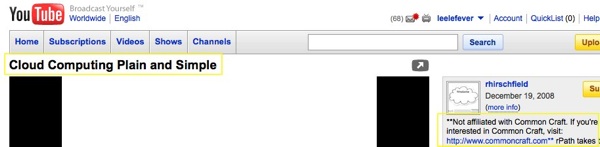
Update 2: The rPath folks have changed the description on the YouTube video page to say "**Not affiliated with Common Craft. If you're interested in Common Craft, visit: http://www.commoncraft.com**" I appreciate them making this change.

Update 3: Jake from rPath has left a comment on this blog post ("rPath Responds" below) and we have been in toch via email.  I will take Jake at his word when he says he didin't know about Common Craft when the video was made.  Of course, as I told him, knowing then and refusing to make a change to make it right now are two different things.

Deleted Comments rpath by you.

Deleted Comments rpath by you.


What To Do About Copy-Cats?

Posted by: leelefever on October 15, 2008- 5:00pm

Categories: feedback, legal, ourwork, thissite

For quite a while now, we’ve been flattered to see others create videos that appear very similar to ours. In many cases, these are positive videos that are used as classroom exercises.  We encourage others in the education world to create Common Craft-inspired videos. Of course, some producers have taken the idea in new directions and mediums, which we also encourage. Further, some producers choose to publicly attribute Common Craft for inspiring their work - and we deeply appreciate this kind of recognition.

However, we’re seeing a growing number of professional (and non-professional) video producers pass off the exact Common Craft Paperworks format as their own original idea. We often get email from fans pointing to these videos as “rip-offs??? or “copy-cats.???  We certainly see this point of view and are concerned about the potential for these videos and producers to harm our brand.  However, figuring out how to react is not something we take lightly.

As a small, open-minded company, we’re looking for good and responsible ways we can protect and promote our brand without discouraging those who are inspired by our work.

Here are some examples that concern us…

  1. A creative company produces a video for a large company that is heavily inspired by Common Craft. The videos are presented as an original idea and format and the large company is impressed – until they discover that the video is a copy of Common Craft videos. The producers are seen as copycats.
  2. Video producers post Common Craft inspired videos to YouTube.  Often commenters say things like “what an original format!??? or “you’ve figured out a great way to present information.??? These comments are evidence that others can take credit for a format we originated.
  3. We receive emails that say “I see that you’ve done a video for XYZ Company and I’d like you to do one for me.???  The problem is that we didn’t create the video for XYZ Company.  The viewer is being confused because we are tied so closely to the Paperworks format.  Often, these videos don’t represent the quality of work we do and the confusion is bad for our brand.

In these cases, Common Craft's reputation is at stake.  Other producers are creating videos that match almost exactly with our unique style and passing them off as their own idea, without ensuring the level of quality that people expect from our work.  It unfairly lets producers take credit for originality that is not their own, and lets videos of any quality be confused with Common Craft.  From our perspective, the problem isn’t copies, it’s copies without attribution.

We're not surprised, but we do recognize our challenge is encouraging video producers to do the right thing – to make clear the source of their inspiration and not be seen as a copycat.  We don’t want to limit a producer’s ability to make videos and a living using any format they choose – but we think it’s better for those producers and Common Craft if everyone is clear with viewers about Common Craft’s role in the process.

Some questions:

Is this a realistic perspective?  Is it fair to expect clarity via attribution?
What are the best ways to communicate our expectations, if it is fair?
What are other ways we can limit confusion without squelching the potential of those who are inspired by our work?

Building a New Foundation for Common Craft

Posted by: leelefever on September 22, 2008- 5:00pm

Categories: business, legal, ourwork, strategy, video

For the last few months, we've been "foundation building."  For us, this means taking the time to focus on the business behind Common Craft and how we communicate our business to you. Our goal is clarity - if we are clear about the exact business that we run, then we're more able to illustrate our value to potential customers. It's hard work and something we're excited to see come to fruition. Now that it's in place, we can really focus on videos.

The elements of the foundation:

Licenses - We've had a great experience reviewing our licenses. For the first time, a legal team worked with us over a matter of weeks and learned our business from top to bottom.  They asked questions, they challenged us, they made suggestions.  We came out of it with a new license agreement that:

1.  Matches exactly with the business we want to run
2.  Matches our plain English style (it fits on one page!)
3.  Gives us confidence that our licenses are solid.

These are our snazzy license icons that appear at the end of each video:

individual icon 50 by you.site icon 50 by you.commercial icon 50 by you.

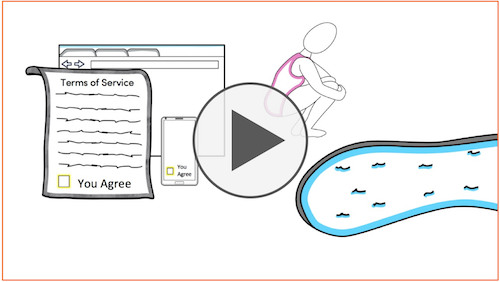
Education - Coming out of the review process gave us new insight into the big ideas we must be able to communicate about our licenses.  We updated our FAQ, created a Licensing Guide and a new video that describes how to share Common Craft videos responsibly.  It's now on the front page and on the Store page - and below:

Equipment - We've reinvented our studio to make video production more comfortable and efficient. You won't see big changes in the videos, but you might notice smiles on our faces thanks to having a studio set up that makes production a joy.  The big change?  We moved the whiteboard off the floor and onto a table, mounted the camera from the ceiling,  added a connection to a TV and clamped on smaller lights with less heat.  This is hopefully our foundation for years of videos to come.

Our Studio by you.


New Commercial License - As a result of our review, we're now offering a new Commercial License.  This license is for companies that would like to display Common Craft videos on their public-facing web site.  We ask these customers to fill out a form to apply for a Commercial License.

New School Program - We want students to benefit from our videos.  We're now offering a special deal for schools of all types.  Entire school districts (K-12), independent, and post-secondary schools only need to purchase a single Site License to use licensed versions of our videos.  Further, the Site License is offered to schools at a 50% discount. Apply for the discount here.

New Format: Kindle Books - We've started to adapt our videos into Kindle books that are availabe for purchase from Amazon's Kindle Store.  More on this later. 

Kindle Books

So, we've been busy behind the scenes, but now we can focus once again on videos for you.  We've been receiving some great suggestions for future videos. If you have one to add or have any questions, please don't hesitate to contact us.

No Love for SFX Baseball's Strong-Arm Tactics

Posted by: leelefever on July 29, 2007- 5:00pm

Categories: disruption, friends, legal

I just got an email from Patrick O'Keefe, a friend that I've known through the web for years. His story got my blood boiling and I want to share it.

Updated:  Patrick will not have to give up his site (for now).  

Patrick owns a Mariano Rivera fan site at MarianoRivera.com. Here's the banner - notice the "unofficial" part. Rivera is a relief pitcher for for the NY Yankees.

Just recently he was contacted by SFX Baseball, who represents Rivera. Without any other contact, they have accused him of cybersquatting and creating the site to...

trick people into coming to this website instead a website operating with Mr. Rivera's approval.

Further...

they "demand" that I immediately cease and desist my use of the domain name and give it to them. They want written confirmation saying that I will do it by 5:00 PM on August 10 or they'll... well... do what they need to do without any further notice to me.

Now, I am not a lawyer, but I imagine that Patrick may end up having to give up the domain - but it's not about that. This article has more info on the personal name/domain name issue.

What gets me (and Patrick) is the automatic accusation of unethical behavior. The lawyers came to him having ruled, judge and jury, that he is a thief or criminal. Maybe the sports and music lawyers should get together - strongarming is sooo 1980.

Patrick and his site are completely legit, as he says:

It's not like we're selling forged autographs, trying to trick people into something or passing ourselves as official. This is a good fan site. We've been in operation since April 4, 2004 - that's 3 years and nearly 5 months. We are the largest (and perhaps only) Mariano Rivera fan site on the internet.

Again, this isn't about the legal case - it's about being cool - you know, like The Fonz. I get so frustrated when I hear about lawyers reacting this way. Haven't we moved on yet?

To blindly throw around offensive boilerplate letters and try to throw us up against the wall like a typical cybersquatter is completely, completely inappropriate. I don't know why they couldn't have approached us respectfully and asked nicely? Maybe thanked us for what we've done and offered to work with us or something.

He is a fan with nothing but good intentions to support an athlete - and they treat him like a criminal? Patrick's site is about the best, most wholesome and legit site Mr. Rivera has on the web right now.

I wish Patrick the best in fighting this. More than anything, I want to bring light to tactics that I sincerely loath. I have no love for people that work this way. Patrick deserves better. Pass it on.

More on this story here.

Recent Post Topics

Subscribe with RSS