all posts tagged “show”
We have just been notified that The Common Craft Show is an Official Webby Award Honoree in the category of Technology Film and Video. Yaaaay!
What does it mean to be an honoree? From the Webby Awards web site:
Of the more than 8000 entries submitted to the 12th Annual Webby Awards, fewer than 15% were distinguished as an Official Honoree.
Basically, we made the short list but didn't quite make it to being a nominee, which is eligible for the award. It's still wonderful to be recognized among such a creative and innovative group. Congrats to the nominees and thanks to the folks who voted for us!
I while back I wrote about solving problems when they need to be solved - and it's still very applicable. With every video we continue to learn and solve new problems.
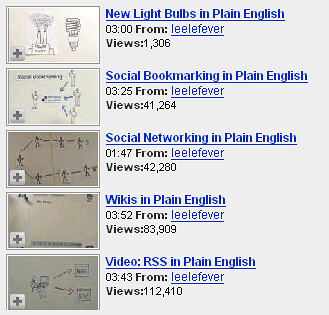
In almost any video project, lighting is a huge factor we've learned so much. There are few more stark examples of our learning curve than the listing of our videos on our YouTube page. Notice the gradation of the white backgrounds:
You can see, right in the listing, our learning curve. Here are a few things we learned:
- Software works for lighting. We use Final Cut Express for editing our videos and Sachi has become a pro at adjusting the videos to be more bright using the color correction settings in the software. Color temperature is a big factor in making the whites look clean and bright.
- Exposure. We have become much more manual users of our camera - a Sony DCR - PC1000. We experimented with exposure and have found a manual exposure setting that works on the whiteboard. It's easy to tell when it's over-exposed by the look of skin tone. Also, over exposed videos come out pink when viewed online.
- White Balance. The same is true for white balance - manual settings create consistency.
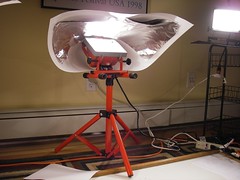
Of course, when it comes to the actual lights, we're still using good ole' shop lights from the hardware store. We'll continue to tinker with these - maybe the tinfoil and posterboard isn't sustainable and may be a fire hazard.

Either way, we're excited to have discovered small things we can do to raise the visual quality of the videos.
When we got started with the Common Craft show, it would have been easy to feel overwhelmed. We were stepping into the world of video production and in that world there is a lot to know. Looking back - we had something very valuable on our side: ignorance. We didn't know what we didn't know. Had we done all the research and tried really hard to make videos the "right" way from the start, I don't think we would have been as successful.

Our experience in the last 5 months has taught us something that we refer to often: Problems get solved when they need to be solved. Looking back, our ignorance allowed us to get started quickly and focus on content. We didn't know how to produce quality sound or light and in the RSS video, it shows. The thing is, it didn't matter to most.
Once we got that first video up, we could look at it and see the problems. The audio is poor. So, we fixed it. Then we looked at the second video and noticed that the lighting wasn't up to snuff, so we fixed it. These big problems made some of the details so small we didn't notice - and that was good because the details might have taken away our focus.
These days we've solved the big problems and are taking the small ones one-by-one. One example is exposure settings. Each time my hand entered the frame, the color of the whiteboard would appear to change. Within a few days, we figured out how to fix it with camera settings or software. We didn't even notice this before because the other problems needed solving first.
Here's the lesson from our experience: If you're about to start something new, don't spend weeks trying to make the first attempt perfect. Get started as quickly as possible and learn as you go. Tinker, experiment and look for the big things you can tackle as you go. Solve problems when they need to be solved and you won't feel as overwhelmed by all the things that could be fixed.
Since our first couple of videos came out, I've been talking to a lot of people about what makes the Paperworks format work. Aside from the content/message, I often say that a set of constraints is what makes the format a great fit for our goals.
In this case, a "constraint" is a rule that we have decided not to break in making our videos.
Examples: We only use certain materials (paper, whiteboard, markers, string), we won't make a video over 4 minutes long, we only use our hands to tell the story and we don't use any external music (just humming, snaps, claps, etc.). Further, everything we make in the format is 100% copyright infringement free. These are the Paperworks constraints and they have a huge impact.
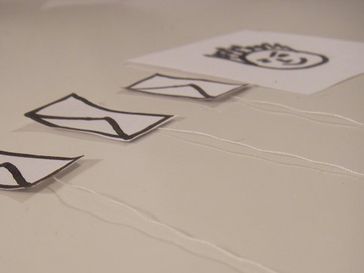
You might think that having constraints is limiting, but I think the opposite. Constraints are liberating. By narrowing the scope of possibilities down to only a few ways to present ideas, we can eliminate needless decision making and complexity.
Consider these examples:
Materials: By limiting ourselves to paper, markers and a whiteboard, we don't have to think about all the things we *could* do with flash animation, 3D, focus, perspective and the like. Our materials, while limited, keep us lightweight and simple.
Time: By limiting the video's possible length to 4 minutes, we limit ourselves to major points. We don't sweat the small stuff.
Hands: By using only our hands, we don't have to think about clothes, hair, make-up or even facial expressions.
Music: By not using external music, we don't have to pick the right song or worry about being sued.
The Lesson: The lesson is that constraints work to limit the number and depth of decisions we have to make. By eliminating the decisions about technology, presentation, music, etc. we have time to focus on the core of what makes Paperworks work: the ideas.
The essence of the Paperworks format is simplicity - bringing down the bar of technology and presentation to it's most basic level. By doing away with fancy graphic and soundtrack options, we can make room to think more deeply about the idea and concept that will convey the message in the simplest way we can. Further, it's a format almost everyone can use - it's not limited by complex technologies.
A Bit of Inspiration: If you haven't read The Paradox of Choice by Barry Schwartz, I recommend picking it up. It made me think about the hidden dangers of having too many options. Another inspiring book is Made To Stick by Chip and Dan Heath, which I reviewed briefly here.
Common Craft (the company, not the blog) is in the midst of a change. It appears that we're becoming, quite fortuitously, a video production company.
This is our story:
As many of you know, Sachi and I traveled around the world in 2006. Along the way, we started making short videos and fell in love with putting our work on the web. Towards the end of the trip, we started to think about how we could use short videos for Common Craft. In October of 2006, an idea was born: we would make video reproductions of our Technology in Plain English blog posts.
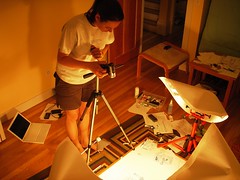
After we came home, we created a shabby studio in an extra bedroom and I started video taping myself in front of the whiteboard, working through ideas like RSS in Plain English. It wasn't working - I felt like just another talking head. We needed something different.
Sachi came up with the idea of pointing the camera straight down at the whiteboard and using my hands to tell the story using simple language and tools. Soon after, our minds ran wild with ideas and we started thinking about the first video, focused on RSS.
We made some mistakes, but that video was our first indication that the soon-to-be-named "Paperworks" format works. The RSS in Plain English video has been viewed over 100,000 times and translated into 16 languages in the first two months after production. Our second video Wikis in Plain English was also well received.
For the second video, we added a section to the Common Craft Show page that says:
We Need You. We're looking for sponsors and opportunities to create videos for specific purposes. Interested? Contact Us.
Soon after the wiki video started making its way around the web, we started to get emails and calls. The more people we talked to, the more we realized the business opportunities. As I write this, our schedule is filling up with videos that we will produce on a commissioned basis. Suddenly, we have become a consulting *and* video production company - and we love it. This could be a big part of the future of Common Craft.
To provide a little more information on our process and goals, we created a page for Common Craft Video Productions - the newest addition to the two-person Common Craft empire. Now more than ever, we see that Common Craft is whatever we want it to be.
Oh, and one final note: we will continue to make our own videos for the Common Craft Show, but our "productions" will be separate.Â
Just after posting our first video on RSS , I learned a few valuable lessons:
1. Video is inaccessible for the hearing impaired
2. Video is not easy to translate into other languages
3. There is a new site that addresses both of these issues called DotSub .
DotSub makes it easy for me to transcribe the spoken words into text subtitles. Then, once the subtitles exist, it enables DotSub members to voluntarily translate the text into other languages and post the video to their blogs. This makes videos international and more accessible - for free.
So far, the Wiki video has been translated into Chinese, Dutch, German and Swedish . The RSS video has been translated into 11 different languages . I'm just amazed.
Here is the Wiki video in a player that allows you to change languages. Use the Up^ and Down arrows at the bottom to see the subtitles.
The Verdict: Exceeded Expectations
You're going to have to forgive me, I'm about to spew all sorts of facts and figures while at the same time stroking my ego. I fear that it will sound like bragging , but we were completely blown away by the success of the RSS in Plain English Video and I want to share.
The video was posted on April 23rd, 2007. Today is May 28th and in just over a month the video has been...
- Viewed over 80,000 times across three hosts (Blip.tv, YouTube and DotSub)
- Translated into 9 languages (subtitles)
- Commented on 160 times (across sites)
- Dugg 975 times
- Added to Del.icio.us 795 times
- Linked-to over 680 times (says Technorati)
Of course, all this has been quite good for the Common Craft web site. In the same month, the site has...
- Gained over 400 new RSS subscribers
- Reached Technorati Authority of 980, Rank of 2146
- The blog entry containing the video has been viewed 46,000+ times and has over 100 comments
- Gained more visitors by maybe 20%
And this all culminates in one big objective for us: Let's try to do THAT again!
We have been working on making The Common Craft Show page more usable and of course, creating a new video which is just a couple of days from release. More info soon. Here is the banner for the new page.

I'm really trying to lower my expectations for the sophomore effort, but I can't help myself. I enjoy making and sharing these videos so much that it scares me.