all posts tagged “email”
How fun. Imagine my delight to wake up the last couple of days to find thousands of bounced emails - all with my address in the From: line. It's such an honor to see my address associated with other legitimate brands that are so proven in the fields of appendage enlargement.
Here's what happens...
A spammer needs to send spam emails and they don't want to use an address associated with them. So, they add someone else's address to the From: field of the email. When the email bounces, it comes to the person's address. In this case, me.
Spoofing is a pretty common problem, but still painful. Apparently, there is little that can be done aside from filtering the incoming messages and hoping that people don't think you're sending the spam. I'm looking into adding an SPF (Sender Policy Framework) record, which can also help, I hear. Any other tips?
At the moment Google reader tells me that I have 490 unread items. Once again my feeds are mocking me. The problem is that of the 490, I'll think 4.9 were really interesting. Such is the blog world I suppose. This kind of minor overload is one of the reasons I love the Very Short List.
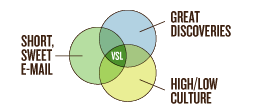
It's a single email 5 days a week (with a web site) that succinctly reviews a tidbit of semi-obscure pop culture. They use great writing and cool little Venn Diagrams to explain their product and each subject they cover:

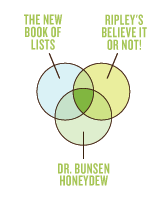
For example, a recent subject was A Compilation of the Very Strangest Scientific Papers. Here's the Diagram they used to explain it.
The Very Short List does one thing very well - and they do it in a unique and engaging way. It's simple, usable, entertaining and it works for me in 30 seconds every morning. I wish at a few more of those 490 blog posts would do the same.
How long has it been since you really thought about all the things you subscribe to in email? The newsletters, the notifications, the email lists. It's so easy to delete the old stuff when it comes in that you might be used to doing just that - deleting instead of unsubscribing.
I've spent the last couple of weeks unsubscribing from everything and I was amazed at the sheer number of things that came in, but always went unread. My guess is there were 25-30 different newsletters and updates. I had no idea.
My advice is to be aware and remove the things you're not reading if you have a choice. It's quite liberating. Now, if I can just figure out how to unsubscribe from spam, I'll be all set.
As many of you may know- RSS is a way for you to "subscribe" to a web site so that you are notified whenever something new is posted. More and more sites are creating RSS "feeds" that allow you to subscribe to them without providing an email address. You need a newsreader to "subscribe".(More on RSS basics here)
This entry will describe how you can create an RSS feed and then post information to the feed by sending an email to a specific address.
Robin Good pointed me to a new tool tool that can allow anyone to create an RSS feed using email. Let me explain how it works...
1. You sign up for MAILbyRSS and they send you an email that contains the vital information. The two basic pieces of information are:
- RSS posting email address (for posting)
- RSS channel (for subscribing)
2. Any mesage that you send to the posting address will be converted into an RSS subscription feed. To test, send an email message to the address, open your news reader and add the new RSS channel. You should see your email mesage appear in the newsreader.
3. So, this means that any message you send to that specific email address will be automatically made into an RSS feed.
Possible Uses:
You could add a link on your website for "RSS". The link would be to the "RSS channel" address mentioned above- which people need to be able to subscribe to your news. Then, if you want to post a newsletter, daily comments, etc. to your subscribers, all you have to do is send your post to the RSS posting email address and it will appear in subscriber's RSS feeds.
As Robin mentions, Yahoo! Groups owners can use this tool to create an RSS feed for a Yahoo! Group. In this case, all the group owner would need to do is subscribe the RSS email address to the Yahoo! Group. This way, the messages posted to the group are sent to the RSS email address- which is automatically converted to an RSS feed.
Informatics: Gates foretells death of spam
Ok, he didn't say those exact words, but he's a believer that technology will eventually beat spammers. He recently spoke at ITU Telecom World 2003 in Geneva.
He called on anonymity to be removed from internet protocols like SMTP, because it allows spammers to mimic other users, and suggested that passwords could be replaced by smart cards and biometric technologies.
"We have to know who is accessing the network. By being able to identify who the sender is we will be able to make the spam problem essentially go away," he said.
Let's hope he's right.
I also liked what the Marketing Wonk folks had to say about it...
Let's hope he's correct and that this prediction will prove more accurate than his previously-predicted demises of the Internet, open source code, Apple and the Sherman Antitrust Act.
News.com reported recently that the CEO of Phones 4 U has banned email in the office.
"I saw that e-mail was insidiously invading Phones 4U, so I banned it immediately," Caudwell said in a statement. "Phones 4U staff have been told to get off the keyboards, get face-to-face or on to the phone to colleagues.
While I can certainly see how email can waste time, this seems extreme. This CEO is throwing out the baby with the bathwater. Here are some things that I think are bad about a policy like this and how I think Phone 4U shoulde handle it:
Forcing Synchronous Communication
One of the virtues of email is that it's asynchronous- it doesn't matter if the receiver of the email is paying attention or not- the message is still delivered. No one has to worry about meeting times or dealing with voicemail systems- if you have a question, ask it in email and let the person reply as they can.
By forcing synchronous interactions, Phones 4 U could be preventing workers from working on multiple projects because they'll constantly be waiting for one another's time and attention to get answers or directives.
Information Management
Particularly for a company who uses email frequently, the email serves as a to-do list manager archiver of knowledge. Employees use email to remind one another of deliverables and to look-up past discussions. Voice mail is insufficient for managing this type of information and so are meetings. Without it, employees will lose a valuable way of managing their productivity. Left with voicemails, meetings and pen and paper, they will lose the ability to manage their work as easily.
Internal Relationships
Loyalty and corporate culture are highly related to relationships among employees. These relationships are created, in part, through the use of office communication tools. IM, emails, the phone, meetings etc. By removing email, employees may get closer to a small group of people, but may be isolated from the larger, more informal relationships that are needed for networking.
The asynchrony of email allows people to communicate less intrusively. When contacting someone they do not know, email offers a way to communicate without real interaction. This may sound like a bad thing- but forcing interaction when all that is needed is an answer can be intimidating for some people. People may delay or even choose not to contact someone if they are forced to interact with them directly. Email helps the introverts get work done.
Therapy- Not Prevention
I think Phones 4 U should not see email as a plague, but a useful business tool that needs management. Instead of stamping it out, the company should look for ways to ensure that employees understand when and how to use it appropriately. Without some management, training, guidelines, etc. it can be a monster, but used effectively it can fill in gaps where synchronous communications fail. Therapy- not prevention.
InfoWorld: E-mail's special power: September 12, 2003: By Jon Udell
I really liked this article about email. Jon Udell asks what would happen if all email crashed- what would we use to replace it?
By asking these questions, he helps to define the best uses of email. By looking at a world without email, we begin to see how other technologies like RSS, Weblogs, Instant Messaging etc. can fill in the gaps. But, most importantly, it shows what gaps cannot be filled. The result is what email is best at doing- its special power...
Jon on email's ability to form and dissolve ad hoc groups:
Every interpersonal e-mail message creates, or sustains, or alters the membership of a group. It happens so naturally that we don't even think about it. When you're writing a message to Sally, you cc: Joe and Beth. Joe adds Mark to the cc: list on his reply. You and Sally work for one department of your company, Joe for another, Beth is a customer, and Mark is an outside contractor. These subtle and spontaneous acts of group formation and adjustments of group membership are the source of e-mail's special power. Without any help from an administrator, we transcend the boundaries not only of time and space but also of organizational trust.
InfoWorld: E-mail's special power: September 12, 2003: By Jon Udell
Via: Ross Mayfield
MarketingSherpa.com : Email Survey Says Email Not Dead
According to 2,327 marketers in-the-field who reported their data in last week's MarketingSherpa Email Metrics Survey, email is not dead yet. Not even close to dying. (Not even coughing a little.)
Last week I said email is not dead and I was happy to see these results. The writers say that companies are learning to measure and test more effectively and this is contributing to better rates.
I personally don't focus on email marketing. I do, however, believe email is the most effective way to raise interest and participation in online communities- which is a form of marketing I suppose.
When my Mom is ready for an alternative to email, email will be dead. When there are as many RSS aggregators as browsers, email will be dead. Until then, viva la email.
Via: ReachCustomersOnline
Warning- Idealistic Rant Ahead.
There seems to be cacophony of folks out there proclaiming email is dead. While I know they are being sensationalist about it, I think the idea is absurd. I think it is temporarily polluted and perhaps unwieldy, but not dead.
Did the telephone die when telemarketers started using it? Did the US Postal Service die when junk-mail started coming? No. It made these resources more annoying, but it didn’t interfere with their basic functions. Telemarketers don’t keep me from calling my brother, junk snail-mail doesn’t stop me from mailing a contract and spam doesn’t stop me from using email many, many times a day.
Like the phone and snail-mail, email is a foundation or standard, not something that will die because it gets exploited by marketers. Email is too much a part of Internet life to be cast aside because it’s less easy to use.
I think we LOVE email- it is absolutely essential to those who use it. And when we see it being abused, exploited and undermined, it hurts and makes us want to turn our backs and say it is ruined- to give up. It is the pain of seeing our beloved resource become co-opted by idiots that makes us want to scream from the mountain tops EMAIL IS DEAD.
But it’s not dead for everyone or forever. The Internet is still new; email is still new. There is a world of people and businesses that are just starting to see the light of Internet communication and the future of email could be bright.
The folks pronouncing its death have the benefit of years of experience at the leading edge of Internet technology and from this perspective they can see past email and be ready to cast it aside for the next big thing. However, I think they are losing the sight of those that are years behind them on the learning curve.
Sure, viruses will attack email, spam may grow, but I think its all part of the ongoing and hard-fought battle between opposing sides of Internet technology. My bet is that spam will eventually lose this battle.
In the end, I believe that spam will die a slow death because it will cease to be profitable. Technology will fight it, recipients will ignore it and it will fall by the wayside. It may take years, but we will have our inboxes back and email will continue to be a valued foundation of our communications in the future.
So, let’s not be so ready to read a eulogy for email. It’s in a sad state right now and it makes me mad too. However, I don’t want to promote the idea that it’s dead because it could still have so many positive affects on the world of online communication- particularly for those who are just beginning to understand it.