all posts tagged “licensing”
The Web really is a wonderous thing. Thanks to e-commerce tools like e-junkie and paypal, two people can run a home-based business with global reach. We've been offering digital downloads of our videos via this website for about 2 years and recently took a look at the makeup of our customers in terms of nationality. We've licensed videos in 41 countries in all. Below are the top 20.

We've always had a goal of being as global as possible, which is why we've had ten of our videos translated with voice-overs in 5 languages. We plan to do more translations in the future. Over time, we've also tried to move away from using text in the videos because it makes translated videos more difficult to understand.
Among our favorite licensing customers are teachers and school districts. We take a lot of pride in making videos that are used to educate students and staff. From time-to-time, we ask school systems for feedback and information on how the videos are used. Below you'll find a short case study about how this system is using the videos. The school system prefers that we not use their name in this post, but the information is from their technology coordinator:
Please tell us the basics of your school system. Size, location, personnel, public vs. private, etc.
We have 30 schools that serve over 16,000 students. We have approximately 1200 teachers and 2100 total staff.
How did your school system find out about Common Craft videos?
We found your work through YouTube/TeacherTube while creating/offering Professional Development on Web 2.0 tools a few years back. We primarily streamed the content, but as we began developing an online hybrid course for our 6th grade students, we looked deeper into your offerings and purchased licensing for the Social Media Pack to include in our course. Our 6th grade course is part of the traditional Fine Arts/Phys Ed rotation – otherwise known as Specials in other school districts.
Who is the target audience for the videos? How do they react to them?
Our target is wide range – staff and students. The primary target would be our 6th grade course. The initial videos – blogs & wikis – are not used too much anymore due to our spectacular trainings (haha). Every time they are shown – the staff and students really enjoy them and certainly meets their need of learning without all the techno-garble.
What problem do the videos solve?
They really help solve that introduction and defining “the what is this thing” in clear and simple to understand terms. Too often us ‘techies’ get too confusing so this allows them to watch and learn in a non-intimidating manner (with a good chuckle or two). Since we have them in our LMS, they can review them anytime they need.
How are the videos displayed or shared? Intranet? LMS? DVD? etc.
Primarily our LMS – Moodle at this point. We are looking to move to Angel (budget willing).
Who (in terms of job title) is in charge of the videos and their use/distribution?
Me J Coordinator for Educational technology
What would you say to other schools and school districts about getting the most from Common Craft videos?
These videos are a great for delivering introductory explanations to new technologies in a clear and easy to understand way. I would not say "simple" – because that would imply the lack of content. Each video is full valuable information presented in a fun and engaging way. Students really like that ‘old school’ animation and gets them thinking on ways they can use those same techniques in their own introductory film-making. ‘Experienced’ staff members like them because they are not confused with all of the techno-garble and confusing terminology.
If you're a school district or teacher interested in Common Craft videos, we offer a 20% discount. Just contact us for the discount code. Also, school districts are only required to purchase a single Site license for the entire district. Site licensed videos can be shared on an LMS or intranet as long as access is limited to students and staff. More info here.
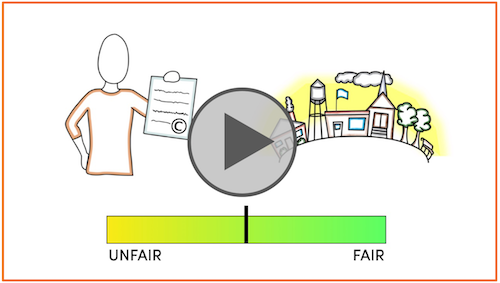
I've been really excited to see the feedback about the new Web License. Asking people to pay to embed a video has raised questions and responding to them has been an interesting experience. If nothing else, it's eye-opening to see what people are assuming about our business.
For example, Mike Masnick at Techdirt wrote an article called "Viral Video Producers Want To Charge You to Embed Their Videos." Then, Steven Hodson at Inquisitor follow up the Techdirt article with "Common Craft Seems to Forget What Makes Viral Video... Well Viral."
Both these articles assume (mostly incorrectly) a few things:
1. Viral video is our business/marketing model
2. YouTube is required to build a business on video
3. Our Web License is focused on viral distribution
It's really interesting to me that, after 3 years of making nearly 30 of our own videos, people still think we're a viral video company. We haven't had a viral hit in a very long time, or thought we could build a business on viral videos. In fact, I'm not sure successful businesses can be sustained that way. I assumed, perhaps optimistically, that a visit to our web site would make that clear.
Now I'm wondering if what has appeared on a few blogs is a widely held perception? Are we not explaining our own business well enough?
The truth is, we make high quality educational videos - videos that help organizations and individuals accomplish goals. These are videos (unlike most viral videos) that people are happy to pay to license because they are useful. The best we can do is make a quality product and attract people and organizations that want to buy it. Part of this strategy is making commoncraft.com the home of our videos - not a host like YouTube.
The Web License model is something that (as far as we know) has never been offered before. In the context of purely viral videos, it would be a very difficult model. But the value of our videos is not so much in blog posts or viral distribution, it's in solving problems for people and organizations whose job is to inform and educate others, on and off the web. That's where you'll find us in the future.
Amit Agarwal at Digital Inspiration has been a fan of Common Craft for a while and we've always enjoyed his thoughful analysis of our videos and business. The news yesterday about our Web License prompted him to write about it - and question the business case for paying to embed videos. We welcome this kind of analysis.
He writes:
The good old YouTube days are over as Common Craft has created a new “web license” for their videos that would require bloggers and websites to pay a monthly subscription fee for embedding videos on their site. And this is not a small amount.
I am huge fan of the entire Common Craft series and admire the fact that they have come up with such a unique business model to distribute their “high value” content online. At the same time, stories published on blogs, unlike the newswires, stay forever so the cost of embedding a single video could easily run into a few thousand dollars over time and that may not make lot of business sense.
I think there is an important distinction to be made here that explains our licensing model. Amit, and I'm sure many observers, think of online video in the business-to-consumer YouTube model. It's social media currency - something to be shared broadly on blogs for free via YouTube. This is obviously a valid and dominant model. However, it's not the only model for online video. Our approach is based not on bloggers or individuals, but organizations that will put the videos to work.
Over time, we've learned that Common Craft videos can be used as valuable business tools for organizations who are looking for high quality content to attract, engage and educate visitors, and potentially turn them into customers. These videos don't normally reside on blog pages.
In our blog post about the new license and relationship with Wistia we say:
“This means a technology company can educate visitors on the basics of wikis, or cloud computing. A financial institution can educate potential customers on the stock market or borrowing money. A service organization can educate citizens about preparing an emergency kit.”
We're targeting the business-to-business market – organizations that will put the videos to work. We believe that the model makes sense for organizations because the videos can contribute to organizational goals. Plus, these same organizations want the hassle-free nature of embeddable videos that also come with Wistia’s analytics. This is very different from marketing the videos to bloggers.
Of course, this is uncharted territory for us all. Over time, I'm a big believer that we're only starting to discover how video producers can build businesses around quality content. Hopefully this is a step in the right direction.
For a while now, we've heard a common request from potential customers. They want an easy way to license and share Common Craft videos on their website. Today we're announcing a new partnership with video sharing company Wistia that will help us serve this need with our new "Web License."
A Little Background...
We license our videos to individuals and organizations. Two of our most popular licenses (Individual and Site) are for offline use. Customers download video files for use on intranets/extranets, training programs, classrooms and presentations. The videos are really useful internally, but they can't be displayed on public websites. Of course, some customers want to do just that.
Problem Solved
Our new partnership with Wistia means that our customers can license high quality Common Craft videos and use Wistia's video sharing tools to easily display them. This makes adding a Common Craft video to your website:
• Easy - Add videos with simple copy-and-paste embed code.
• Smart - Gather rich info on who watches the videos and how they watch them
• Flexible - Choose from multiple plans, based on monthly views
This means a technology company can educate visitors on the basics of wikis, or cloud computing.
A financial institution can educate potential customers on the stock market or borrowing money.
A service organization can educate citizens about preparing an emergency kit.
Our Web License means that any website can benefit from Common Craft videos.
This 52-second video helps explain the relationship:
If you're interested in licensing Common Craft videos for your website, look for the "Web License" option on any video at CommonCraft.com.
Almost anyone can make a video and put it online, but there are relatively few good models for earning a living from online videos. We've been experimenting over a couple of years and believe more than ever that video licensing is a model that has huge potential.
The Current Options
Of course there's the advertising model. A video is made, it attracts eyeballs, eyeballs are distracted by ads. A tiny percentage of people click the ads and the video host and video owner make a bit of money. It can certainly work and we've experimented with it, but it can be a long, hard slog.
For video producers, it's certainly possible to make a living by creating custom videos. This market is alive, well and growing. More and more businesses are looking for ways to introduce their product or service with a short online video. Some companies are doing very well with it, but it isn't easily scalable for a small company like ours.
Licensing at Common Craft
At Common Craft, we've been working on a model that's used across the media industry, but hasn't caught on in the online video world - yet. I'm talking about licensing, the business of permission.
Here's an example. Think about a video game that needs awesome songs for an upcoming release. There are bands (or labels) that own awesome songs. The video game company is happy to pay to use the songs in the game. This is a licensing relationship. The owners of the songs give the game company permission to use the songs in exchange for licensing fees. It's a tried and true business relationship.
The same is true for stock photos. You can view them for free (with a watermark), but to use them professionally or commercially, you usually have to pay a licensing fee.
Now, let's apply this model to Common Craft. Like songs on the radio, our videos are available on our website. You can watch them for free and they help us build awareness and brand recognition. We don't earn money from permission to watch the video. Instead, we've tailored our licenses for organizations and individuals who want to use our videos to accomplish their professional goals, like adding a catchy song in a video game. These organizations are happy to purchase licensed versions because they're high quality and come with explicit permission for use.
Some examples:
1. A large company needs videos for teaching social media across the organization. Our "Site License" fits the bill.
2. An individual needs videos for workshops and presentations. We have an "Individual License" for them.
3. A company needs useful and compelling content to educate visitors to their website. We have a Commercial "Web License" for these sites.


But it's not always that simple. Thanks to YouTube, which has been helpful in spreading the word about our videos, the assumption for most is that online videos are always free. In offering licenses for our videos, our challenge is education - helping people understand the difference between watching a free video and licensing a higher-quality version for professional use.
It will take time, but the last couple of years have shown us that it's possible to make a living by licensing videos.
Creative Commons
This post would be incomplete without a mention of Creative Commons licenses. Like any license, Creative Commons is about permission, but these licenses are often used to encourage free use. By using a Creative Commons license, the owner is encouraging others to share, remix, reuse the work as long as a few requirements are met. The requirements are up to the owner and focus on attribution, commercial use, alterations, etc.
While we've decided that Creative Commons is not a good fit for our business, it can be a great resource for video producers who are hoping to get their work in front of more people and be discovered.
Get the Ball Rolling
If you're a video producer, it's time to think about the business of permission! Here are a few things to consider:
- Do you own video content? If so, it can probably be licensed.
- Have you ever been contacted for permission to use your videos? If so, that's a licensing opportunity.
- If you haven't been contacted, identify the potential uses for your videos and look for opportunities.
- Look for ways to create a premium version of your videos for licensing.
From our perspective, the licensing side of online video has huge potential. It's great to see companies like Vidvend experimenting with a similar model. Services like e-junkie make digital downloads easy to manage. The tools are there - now it'll just take time for more talented producers to experiment and find how licensing can fit into their future.
This evening we've taken the wraps off the new CommonCraft.com and we'd love your feedback and help.
The biggest change is the new and improved video Store, which is fashioned after the shopping experience on sites like NetFlix. As I've said before, we see the Store as the centerpiece of our future business and we're so excited to have a foundation on which we can build.
To go with the new Store, we've made a video (below) that explains the way our video licensing works. "Common Craft Licensing in Plain English" also appears on the Store's front page.
Share this video using this code:
You'll also see that the site has a similar but improved interface.
We'd love your help!
With Reporting Problems...
As you know, we don't have "testers" or "QA professionals." If you see anything unexpected or erroneous, please do report it. You can leave a comment here or contact us.
With Building Awareness...
We've heard positive feedback from Store customers and we're very confident in our product, but awareness remains as our biggest challenge. People know the videos, but few understand that we offer them for licensed use in the workplace.
This is where you can help. We would be forever indebted if you could help us spread the word. The next time you talk to someone who says "I need an easy way to teach people at my company about social media", you might mention our Store. Of course, blog posts and tweets help too. :)
Ultimately, our potential rides on the Store's success. As it succeeds, we can devote more and more of our time to creating a growing library videos that are useful for non-commercial purposes on the Web and licensed use in the workplace.
As I wrote recently, we've been thinking a lot about Common Craft's future. In the coming year, Sachi and I want to make even more videos for you - videos that are useful, both on the Web and in the workplace. We've recently created a new resource that will hopefully help us get there.
Today we're announcing the roll out of an early version of The Common Craft Store. It looks like this:
The Store is the home for "licensed versions" of our videos. Licensed versions contain the same messaging and content as the free versions, but are improved for the workplace.
Some features:
- Download video files immediately after purchase (credit card, paypal)
- Higher resolution (640 X 480 - better for projection screens)
- Less promotion (no Common Craft Show branding)
- Provided in Quicktime (.mov) for Mac, and Windows Media (.wmv) formats
- No DRM
- Two Licenses:
Site - Unlimited use for a single location of an organization
The Store is a direct response to emails we receive nearly every day asking for permission to use our videos in the workplace. By licensing our videos, we are removing any worries about permission and appropriate use. Influencers and educators now have a resource for downloading and using the videos in presentations, meetings, Intranets, trainings, etc.
What about the free versions?
All of our videos will now be provided in two forms, Free and Licensed. This may help:

We are committed to maintaining the free and open nature of our videos on the public Web. The free versions will be provided under a Creative Commons 3.0 (non-commercial) license. These videos will continue to appear on the Common Craft Show, on video hosts like You Tube and will remain open for use by individuals, schools, non-profits, etc.
By opening the Store, we are creating a channel for professionals who need videos that are easier to access and more appropriate for use in professional/commercial situations.
Our hope is that the Store will allow us to focus more energy on producing videos for the Common Craft Show - videos that will be open to bloggers and the Web, but also for licensed use in the workplace.
If you have questions or concerns, have a look at the FAQ, the Licensing Agreement and the Privacy Policy.


